When you see a horsebox pull up to collect your horse, it can look pretty simple.
Horse gets on.
Horse travels.
Horse gets off.
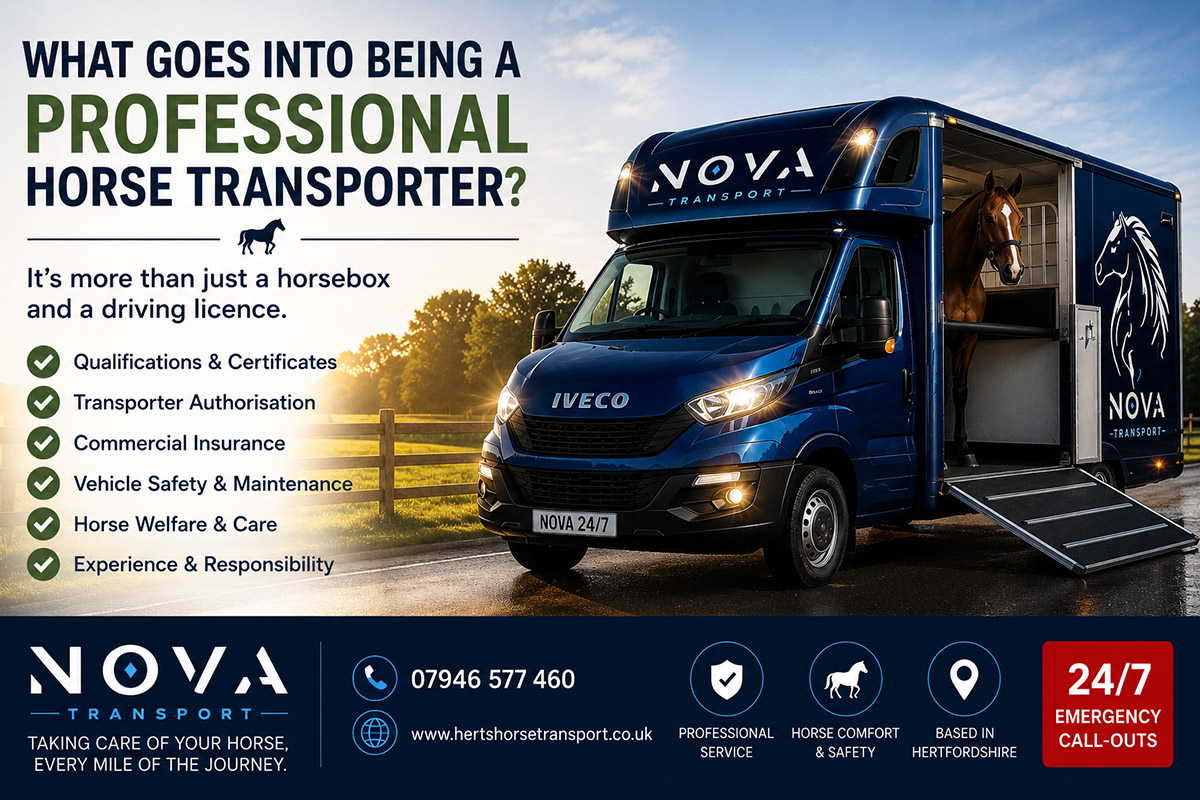
But behind every professional horse transport journey is a lot more than simply having a horsebox and a driving licence.
When you are transporting someone else’s horse commercially, there are legal requirements, insurance requirements, vehicle requirements and, most importantly, welfare responsibilities that all need to be taken seriously.
📋 Certificate of Competence
One of the important qualifications for professional horse transporters is the Animal Transport Certificate of Competence.
For commercial journeys of 65km or more, the person responsible for transporting the horses must have the appropriate Certificate of Competence for the species and journey length.
There are two levels:
🐴 Short Journey – up to 8 hours
This covers journeys over 65km and up to 8 hours. The assessment focuses on the knowledge and understanding needed to transport animals safely and protect their welfare throughout the journey.
🐴 Long Journey – over 8 hours
For journeys exceeding 8 hours, additional requirements apply, including a practical assessment. The qualification covers the additional welfare considerations involved in longer journeys.
The certificate is specific to the role, species and journey duration, and current UK guidance states that certificates are valid for life.
🚛 Transporter Authorisation
Then there is the Transporter Authorisation, which is different from the Certificate of Competence.
For journeys over 65km in connection with an economic activity, a transporter generally needs a UK-issued authorisation:
Type 1 – journeys over 65km and up to 8 hours.
Type 2 – journeys over 8 hours.
These authorisations are issued through APHA.
And for longer journeys, there can be additional requirements, including vehicle approval and tracking/navigation requirements depending on the journey.
🛡️ Insurance Isn’t Just Standard Horsebox Insurance
If you are transporting other people’s horses for payment, you need to make sure your insurance is arranged specifically for commercial horse transport and Hire & Reward.
A normal social, domestic and pleasure horsebox policy isn’t the same thing.
Specialist commercial policies can include Hire & Reward use, while transporters can also arrange additional Care, Custody & Control / Custodial Liability cover for horses belonging to customers.
It’s also worth having suitable breakdown and recovery arrangements that can actually deal with the horse as well as the vehicle if something goes wrong.
🐎 And Then There’s The Horsebox…
A horsebox used professionally isn’t just about getting from A to B.
The vehicle needs to be suitable for transporting horses safely and must be maintained appropriately.
That’s one reason we chose a horsebox that has been specifically designed and built for horse transportation, rather than treating a standard everyday vehicle as simply somewhere to put a horse.
For us, the horse area is incredibly important.
Our horsebox provides features designed around equine safety and comfort, including:
🔹 Padded horse areas to help reduce the risk of injury
🔹 Padded partitions to provide additional protection while travelling
🔹 Rubber flooring for grip, cushioning and comfort
🔹 A large rear exit door which provides an important additional way of getting a horse out of the vehicle
🔹 A proper horsebox partition system designed specifically for travelling horses
🔹 Good ventilation and airflow
🔹 Lighting within the horse area
🔹 A spacious loading and unloading area
That large rear exit is particularly important to us. If a horse ever needs to be unloaded through the rear rather than the ramp, having a large, purpose-designed exit can make a difficult situation much safer and give the horse a clear route out.
🔍 The Checks Don’t Stop There…
Before a journey, there are also practical checks to think about.
The horse needs to be fit to travel, the vehicle needs to be safe, the floor and partitions need checking, loading equipment needs to be secure, and the journey needs to be properly planned.
And once the horse is on board, welfare remains the priority for the entire journey.
❤️ So, What Actually Goes Into Being A Horse Transporter?
It’s not simply:
“I’ve got a 3.5 tonne horsebox, so I can transport horses.”
- It’s qualifications.
- It’s authorisations.
- It’s appropriate commercial insurance.
- It’s vehicle safety.
- It’s animal welfare.
- It’s experience handling horses.
- It’s knowing what to do when a horse doesn’t want to load.
- It’s knowing how to deal with an emergency.
- It’s checking the vehicle before every journey.
- It’s maintaining the horsebox properly.
- It’s having the right equipment with you.
And it’s taking responsibility for somebody else’s horse from the moment you collect them until they safely arrive at their destination.
For us, that’s what being a professional horse transporter is all about.
Because when someone puts their horse in our care, they’re trusting us with far more than a journey. They’re trusting us with a member of their family. ❤️🐴
Transport regulations and requirements can change, so horse owners and transporters should always check the latest official UK Government and APHA guidance.